
Publikasi

SFITAL berkolaborasi bersama Pemerintah daerah Kabupaten Luwu Utara dan Kabupaten Labuhanbatu Utara, dalam menghasilkan produk publikasi yang berkontribusi dalam penyebarluasan pemahaman dan penerapan pengetahuan dalam mengelola kebun, terutama pengembangan kakao dan kelapa sawit berkelanjutan, serta meningkatkan akses terhadap pasar global melalui kemitraan petani, pemerintah, dan sektor swasta.

Adopsi terhadap praktik pertanian baik dan inovasi terus didorong dalam upaya meningkatkan produktivitas dan keberlanjutan. Upaya ini diharapkan agar sektor pertanian berkelanjutan di Kabupaten Luwu Utara dan Kabupaten Labuhanbatu Utara dapat terus berkembang dan memberikan manfaat jangka panjang bagi masyarakat, lingkungan, dan pendapatan ekonomi daerah.

C
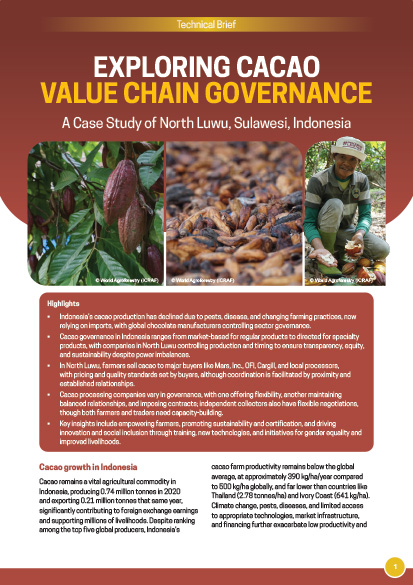
Title: Exploring cacao value chain governance. A case study of North Luwu, Sulawesi, Indonesia
Author: Aulia Perdana
Year: 2024
Call Number: PB00567-24

Abstract:

This study analyzes the dynamics of cacao Value Chain Governance (VCG) in North Luwu, South Sulawesi, to understand how governance structures influence the integration of sustainability measures. While Indonesia remains a vital global producer, national productivity has fallen below the global average due to pests, disease, and climate change, leading to an increased reliance on imports to meet domestic processing demands. Utilizing a framework that identifies five governance types—market, modular, relational, captive, and hierarchy—the research examines how transactions are codified and how power is distributed among stakeholders. Findings reveal that major buyers like Mars, Inc. employ "captive" governance through strict certification contracts, while others like Cargill and Olam maintain more "modular" or "relational" structures that offer varying degrees of flexibility for farmers and local traders.

The evaluation highlights a significant power asymmetry where lead firms largely dictate pricing and quality standards, leaving smallholder farmers with limited bargaining power. Although farmers demonstrate proficiency in meeting technical quality requirements, their understanding of traceability remains limited, posing a challenge to long-term sustainability goals. To enhance the value chain, the study recommends empowering farmers through strengthened cooperatives, increasing awareness of certification and climate-smart agriculture, and investing in digital tools to drive social inclusion. These strategic interventions aim to foster more equitable relationships and ensure the environmental and economic resilience of Indonesia’s cacao industry.

File:

  File Size Description
file type <1737 KB Softcopy